
In this article 9 sections
- What a cheap hearing test usually gives you
- What a complete hearing assessment includes
- Walk through a real PHS report
- How a weak hearing test causes problems later
- Why the Complete Hearing Profile is the best first step
- Built on international standards
- When should you have a complete hearing assessment?
- Book a Complete Hearing Profile
- Frequently asked questions
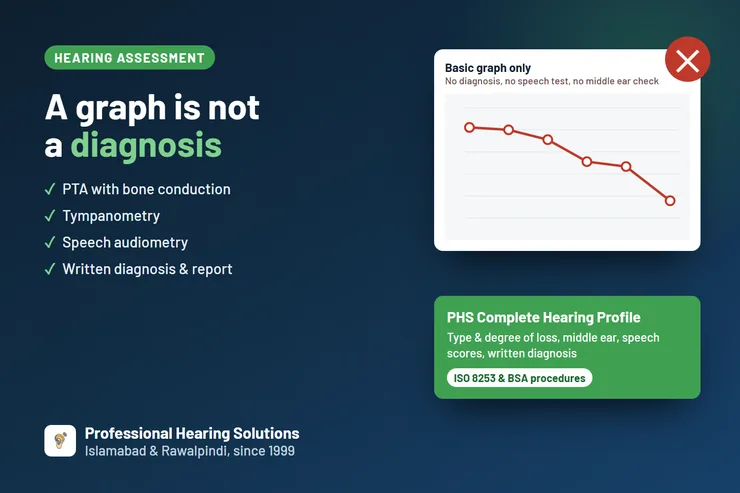
Quick answer: A cheap hearing test usually gives you one graph of air-conduction thresholds and nothing else. A complete hearing assessment adds a case history, ear examination, bone conduction, tympanometry and speech audiometry, then turns the results into a written diagnosis with recommendations. At Professional Hearing Solutions this is our Complete Hearing Profile: about 40 minutes, Rs.5,000, in Islamabad and Rawalpindi, following ISO 8253 and BSA procedures.
Many patients come to us holding a hearing test they paid a few hundred rupees for: one sheet with two lines on it, no explanation and no diagnosis. They still have the same questions they had before the test. Is my hearing loss treatable? Do I need a hearing aid? Which one? A graph cannot answer those questions. A complete hearing assessment can.
What a cheap hearing test usually gives you
Across Pakistan, a basic graph-only PTA costs about Rs.500 to Rs.2,500. For that price you typically get:
A few minutes of beeps through headphones, often in a room that is not sound-treated.
Air conduction thresholds only, plotted as a graph.
No ear examination, no middle-ear test and no speech test.
No written diagnosis, no explanation and no recommendations.
The graph may even be accurate. The problem is that it is incomplete, and an incomplete test cannot give a diagnosis. You leave with a picture you cannot read, and whoever sees it next usually has to test you again.
What a complete hearing assessment includes
A complete diagnostic hearing assessment follows a fixed sequence, because each step answers a question the previous one cannot. This is how we do it at PHS:
1. Case history
We ask what you are noticing, which ear is worse and when it started, and about ringing (tinnitus), dizziness, ear pain or discharge, noise exposure, medicines and family history. The history tells us what to look for in the tests.
2. Ear examination (otoscopy)
A look at the ear canal and eardrum before testing. Wax, an infection or a perforation changes how the results are read, and some of these need an ENT before anything else.
3. Pure Tone Audiometry: air and bone conduction
In a sound booth you respond to tones from 250 Hz to 8,000 Hz in each ear. Air conduction, through headphones, shows how well you hear overall. Bone conduction, through a small vibrator behind the ear, bypasses the outer and middle ear. Comparing the two is the only way to know whether a loss is conductive, sensorineural or mixed, and that decides whether you need an ENT, a hearing aid or both.
4. Tympanometry
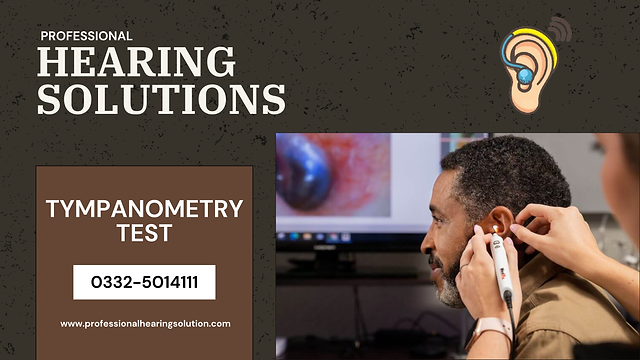
A soft probe changes the air pressure in the ear canal for a few seconds and measures how the eardrum moves. The result (ear canal volume, compliance, pressure and type A, B or C) shows fluid behind the eardrum, negative pressure from a blocked Eustachian tube, a stiff middle ear or a perforation.
5. Speech audiometry
We measure the softest level at which you can repeat words (speech reception threshold, SRT) and the percentage of words you understand at a comfortable level (word recognition score, WRS). We also record your most comfortable level (MCL) and uncomfortable level (UCL). The gap between your threshold and your UCL is your dynamic range: the space a hearing aid has to work in.
6. Analysis, diagnosis and recommendations
Finally the audiologist brings it together: the degree (mild, moderate, severe or profound), type and configuration of loss for each ear, the AAO-HNS hearing impairment percentage, a written diagnosis and clear next steps, from an ENT referral to a hearing aid evaluation or simply a re-test date. Then we explain it all to you in person.
| What you get | Basic graphRs.500 to Rs.2,500 | PHS full reportComplete Hearing Profile Rs.5,000 |
|---|---|---|
| Case history & ear examination | Usually skipped | Symptoms, history and an otoscopic check of the ear canal and eardrum |
| Air conduction (the graph) | Yes, often without proper test conditions | Both ears, 250 Hz to 8 kHz, in a sound booth, following ISO 8253 |
| Bone conduction | Rarely | Yes: separates conductive loss (often medically treatable) from nerve loss |
| Tympanometry (middle ear) | No | ECV, compliance, pressure and type A/B/C for each ear |
| Speech audiometry | No | SRT and word recognition: how well you understand speech |
| MCL, UCL & dynamic range | No | Comfortable and uncomfortable loudness levels, needed to set a hearing aid safely |
| Degree, type & configuration | Left for you to guess | Written for each ear, plus AAO-HNS hearing impairment % |
| Written diagnosis & next steps | No | Clear diagnosis, recommendations and ENT referral when needed |
| Explained by the audiologist | No | In person, in plain language, at the same visit |
| Report you can share | A loose printout | Numbered, digitally issued report any ENT or audiologist, in Pakistan or abroad, can read |
Walk through a real PHS report
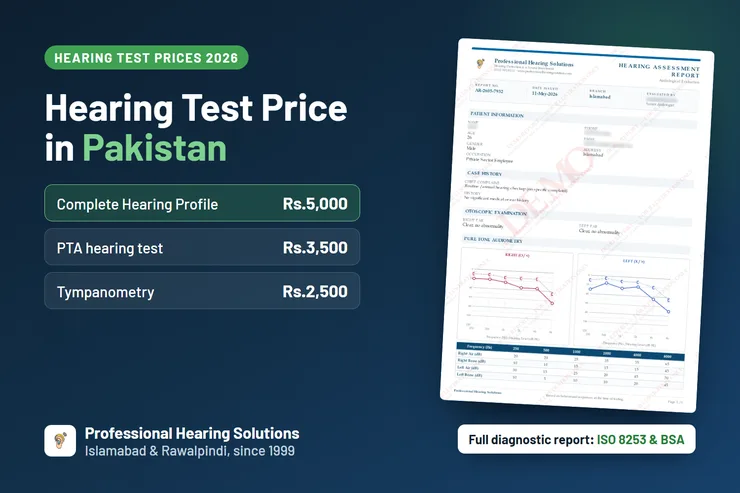
Here is a real PHS Hearing Assessment Report with the patient's details hidden. It is three pages long, and every section is there for a reason:
Sample report, view only
See a real PHS hearing report
This is the report every PHS patient receives after a Complete Hearing Profile (sample patient, details hidden). Compare it with the single graph many places hand out.
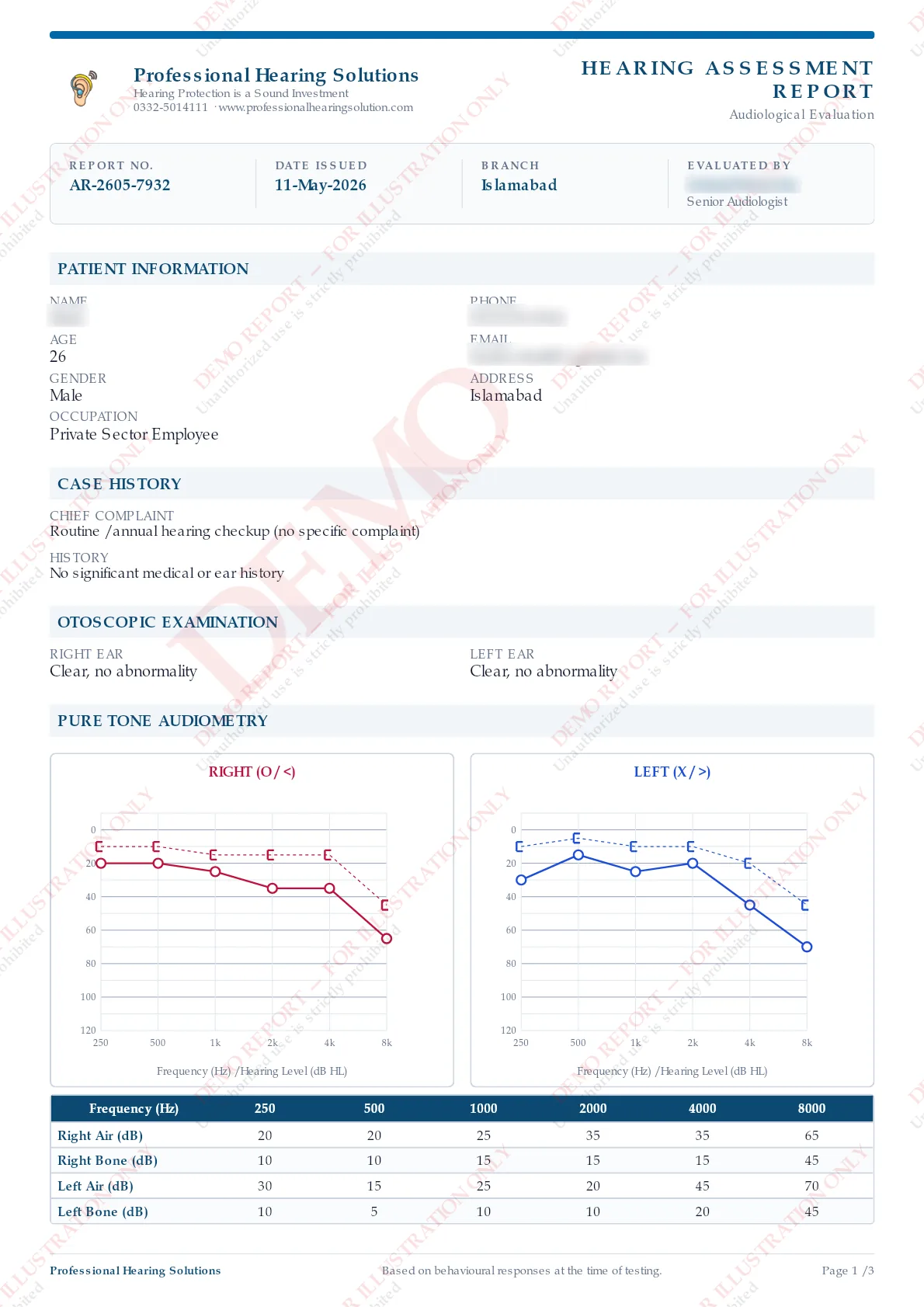
- Page 1: Patient details, case history, ear examination, and the audiogram for each ear with air and bone conduction values at every frequency.
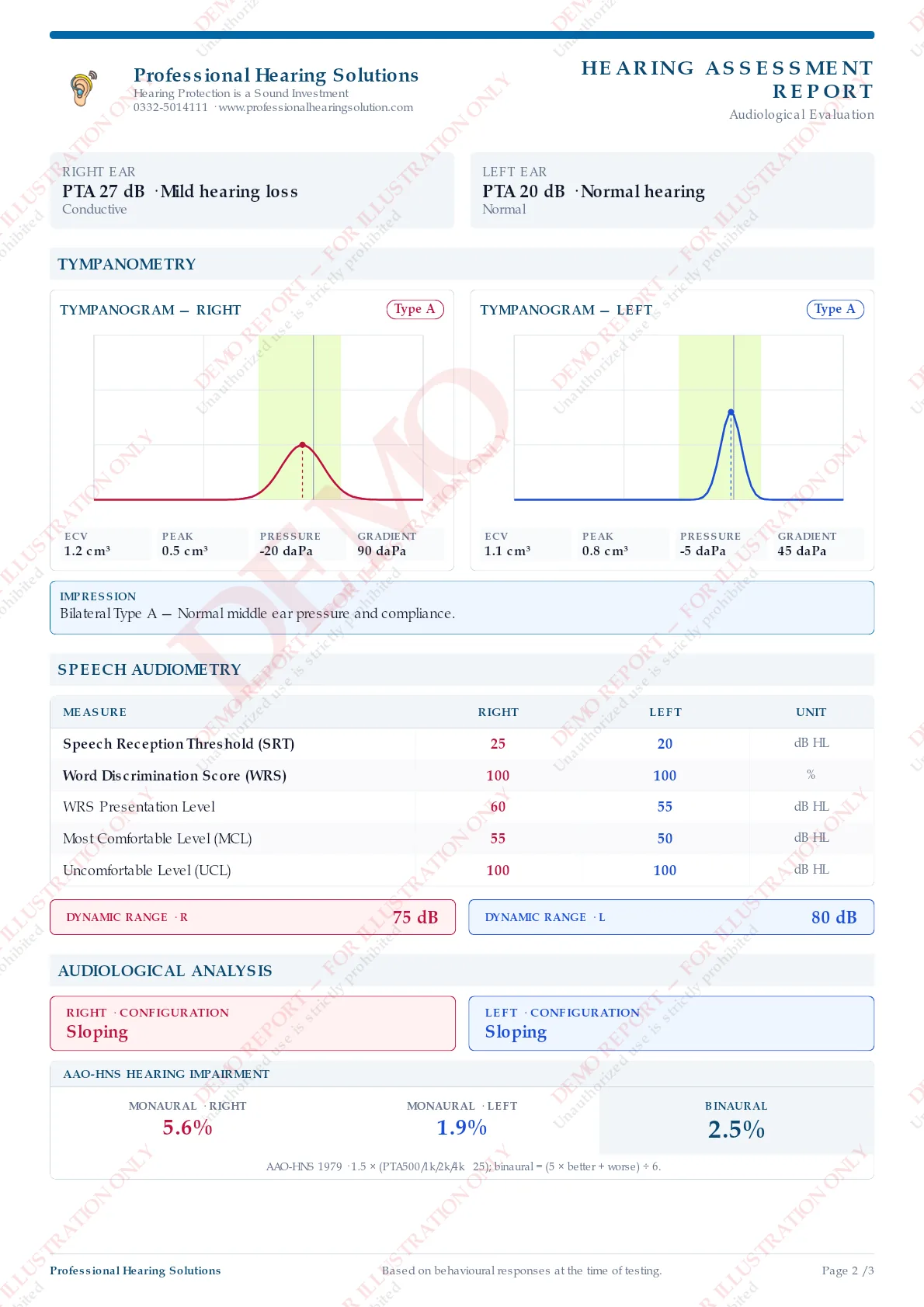
- Page 2: Degree and type of loss per ear, tympanograms with ECV, compliance, pressure and type, speech audiometry (SRT, word recognition, MCL, UCL, dynamic range) and the AAO-HNS hearing impairment %.
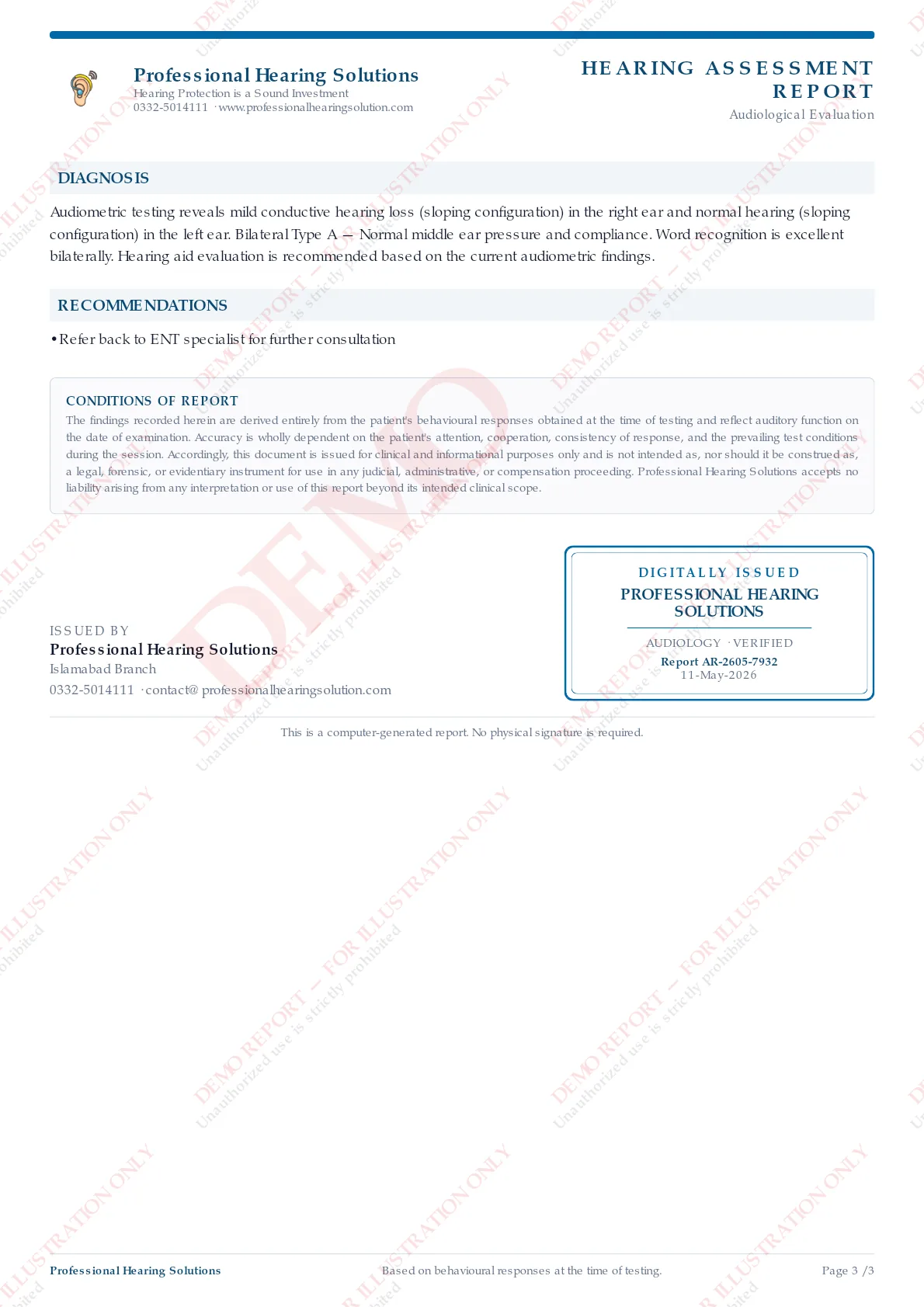
- Page 3: Written diagnosis, recommendations, conditions of the report and the digitally issued, numbered verification seal.
Watermarked sample for illustration only. Every patient receives their own confidential report.
Page 1 records the history, the ear examination and the audiogram for each ear, with a table of air and bone conduction values at every frequency.
Page 2 gives the pure tone average and degree of loss for each ear (in this sample: right ear 27 dB, mild conductive; left ear 20 dB, normal), both tympanograms (Type A, normal), the speech results (SRT, 100% word recognition, MCL, UCL and dynamic range) and the hearing impairment percentage.
Page 3 gives the written diagnosis and recommendations, the conditions of the report and the digitally issued, numbered verification.
Notice what this sample shows. The right ear has a conductive component that a graph without bone conduction would have hidden, so the report recommends an ENT review alongside the hearing aid evaluation. That is the value of a complete assessment: the right next step, not just a number.
How a weak hearing test causes problems later
Wrong treatment. A conductive loss treated as nerve loss can mean a hearing aid for a problem an ENT doctor might have treated.
Hearing aids that disappoint. Programmed from rough thresholds with no speech or loudness data, a hearing aid can sound loud but unclear, or uncomfortable in noise. Many people give up on hearing aids for this reason, when the device was never the problem.
Missed warning signs. One-sided or uneven losses, middle-ear fluid in children and sudden changes need medical attention. A graph alone rarely flags them.
No baseline. Without a proper first report there is nothing reliable to compare against, so changes over the years go unnoticed.
Paying twice. Before any fitting or specialist visit, a cheap test usually has to be repeated properly.
Why the Complete Hearing Profile is the best first step
If you have any hearing concern, or simply want a proper hearing check-up, start with the Complete Hearing Profile. It includes PTA, tympanometry and speech audiometry with a written diagnosis for Rs.5,000, less than booking the tests one by one.
Recommended hearing check-up
Complete Hearing Profile
PTA + Tympanometry + Speech Audiometry
Rs.5,000about 40 minutes
PTA and tympanometry booked separately already cost Rs.6,000, before speech audiometry.
- Case history and ear examination (otoscopy)
- Pure Tone Audiometry, air and bone conduction, both ears
- Tympanometry (middle ear and eardrum)
- Speech Audiometry: SRT, word recognition, comfortable and uncomfortable levels
- Written diagnosis, hearing impairment % and recommendations
- Results explained in person by the audiologist
Pure Tone Audiometry (PTA)
Hearing test with report
Rs.3,500about 20 minutes
Air and bone conduction thresholds for both ears in a sound booth, with the degree, type and pattern of any hearing loss written in your report.
Tympanometry
Middle ear test
Rs.2,500about 15 minutes
Eardrum movement and middle-ear pressure (ECV, compliance, pressure, type A/B/C) to find fluid, blockage or Eustachian tube problems.
Hearing Aid Consultation
Choosing the right hearing aid
Rs.2,000about 20 minutes
Your results, needs, hearing aid styles, features and budget discussed before any selection or fitting.
Tinnitus Consultation
Ringing in the ears
Rs.5,500about 45 minutes
Assessment of ringing, buzzing or hissing, and the management options that suit your hearing results.
Home Hearing Assessment & Fitting
At your home in Islamabad or Rawalpindi
From Rs.10,000first hour
Our team brings the equipment to your home for a hearing assessment and hearing aid fitting.
For comparison: in Islamabad, Rawalpindi and the rest of Pakistan a basic graph-only PTA usually costs Rs.500 to Rs.2,500. A proper diagnostic PTA with a full written report costs Rs.3,000 to Rs.5,000, depending on the tests and diagnosis involved.
Prices updated November 2026. Same fees at our Blue Area, Islamabad and Saidpur Road, Rawalpindi clinics.
Built on international standards
Our hearing tests follow ISO 8253 audiometric test methods and British Society of Audiology (BSA) recommended procedures. Results use the international audiogram symbols (O and X for air conduction, brackets for bone conduction), the hearing impairment percentage is calculated with the AAO-HNS formula, and hearing aids are fitted under our International Fitting Protocol. The result is a report that stands up locally and internationally: an ENT specialist in Rawalpindi, a doctor abroad or a future audiologist can read it and act on it.
When should you have a complete hearing assessment?
You ask people to repeat themselves, turn the TV up or struggle in noisy places.
You hear ringing, buzzing or hissing, or one ear feels blocked or weaker.
Before buying or replacing a hearing aid.
After repeated ear infections, or if a child's speech is delayed.
As a regular check-up if you are over 60, work in noise or already wear hearing aids.
See an ENT doctor first if your hearing drops suddenly in one or both ears, or if hearing loss comes with ear pain, discharge, bleeding or dizziness. Sudden hearing loss is urgent: treatment works best when it starts within days.
Book a Complete Hearing Profile
Call or WhatsApp 0332-5014111, or book online. Both clinics are open Monday to Saturday, 10:00 am to 7:00 pm: Office B-9 Basement, Muhammad Gulistan Khan House 82 East, Fazl-ul-Haq Road, Blue Area, Islamabad, and Office 5 & 6, Siraj Plaza, Saidpur Road, Rawalpindi. If travelling is difficult, a home hearing assessment is available from Rs.10,000. See all fees in our hearing test price guide and on the Hearing Assessment page.
Our Promise
100% Original German Signia. Never Copies.
Every Signia hearing aid we fit is the original German product: brand new, never used, with the manufacturer’s 2-year warranty, programmed by our audiologists with genuine Signia software. The market has counterfeit copies of German hearing aids, refurbished and second-hand devices and cheap imitations. We never sell any of them, so every patient gets genuine quality for the money they spend on hearing care.
We never sell:
- Counterfeit copies
- Refurbished devices
- Second-hand hearing aids
- Cheap imitations