Hearing Technology for Special Needs Children
- Hearing Solutions

- Mar 28
- 5 min read
Updated: Mar 29
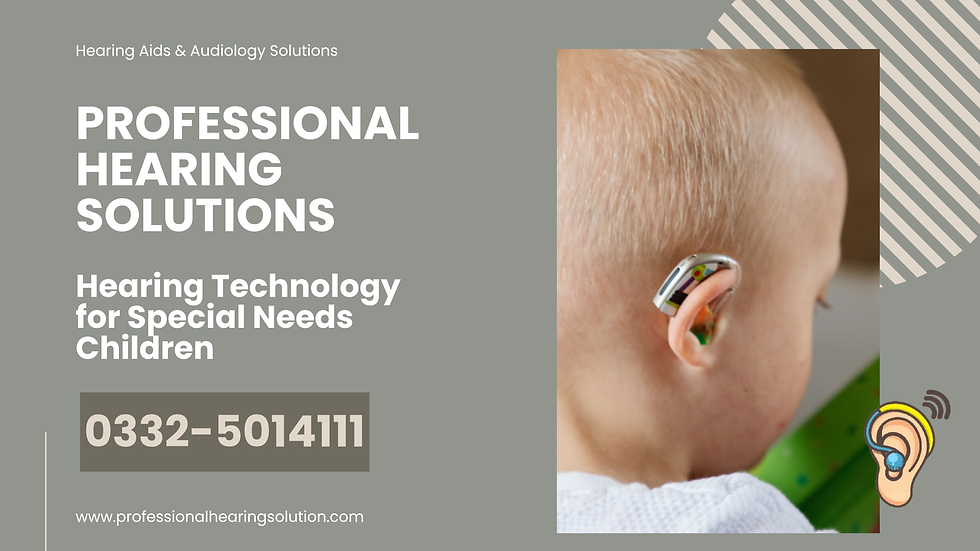
Children with special needs — including autism, cerebral palsy, Down syndrome, and developmental delays — often have higher rates of hearing loss that goes undetected. Specialized hearing technology and fitting approaches can transform their quality of life.
Learn more at Professional Hearing Solutions in Islamabad and Rawalpindi. Call 0332-5014111.
Special Needs Conditions and Hearing Loss Risk
Condition | Hearing Loss Prevalence | Common Type |
Down syndrome | 60-80% | Conductive (middle ear) and sensorineural |
Autism spectrum disorder | Higher than typical | Mixed — often sensory processing challenges |
Cerebral palsy | 10-20% | Sensorineural, often high frequency |
Cleft palate | 30-50% | Conductive due to middle ear dysfunction |
Premature birth | 2-5% | Sensorineural |
Fetal alcohol syndrome | Up to 80% | Mixed conductive and sensorineural |
Challenges in Providing Hearing Technology
Sensory sensitivities — many special needs children are hypersensitive to touch and sound
Behavioral challenges — difficulty sitting still during testing and fitting
Communication barriers — unable to report how hearing aids sound
Motor limitations — difficulty handling small devices
Multiple medical appointments — hearing care competes with other therapies
Caregiver burden — adding hearing aid management to already demanding care routines
Successful Hearing Aid Strategies
Gradual desensitization — slowly introduce hearing aid wearing in short sessions
Comfortable custom earmolds — silicone material reduces irritation
Retention accessories — huggie aids, clips, and headbands keep aids on active children
Tamper-resistant features — locked battery doors and volume controls
Visual schedules — show the child when hearing aids go on and come off
Reward systems — positive reinforcement for wearing hearing aids
Consistent routine — same time, same place for putting aids on and taking off
Support Team Approach
Audiologist at Professional Hearing Solutions assesses hearing and fits technology
Speech therapist works on language development alongside hearing aids
Occupational therapist helps with sensory integration and device tolerance
Special education teacher implements classroom accommodations
Parents and caregivers provide daily hearing aid management and monitoring
Regular team communication ensures coordinated care
How Hearing Loss Affects Daily Life
Hearing loss impacts more than just the ability to hear sounds. It affects communication, relationships, work performance, mental health, and overall quality of life. In Pakistan, where family gatherings, busy markets, and social interactions are central to daily life, hearing loss can be especially isolating.
Common Causes of Hearing Loss in Pakistan
Cause | Type of Hearing Loss | Preventable? | Common in Pakistan? |
Aging (Presbycusis) | Sensorineural | Not fully — manageable with hearing aids | Very common (60+ age group) |
Noise Exposure | Sensorineural | Yes — use hearing protection | Very common (traffic, factories) |
Ear Infections (Otitis Media) | Conductive | Yes — treat infections early | Common in children |
Genetic Factors | Sensorineural or Mixed | No — but early detection helps | Moderate |
Ototoxic Medications | Sensorineural | Yes — discuss with doctor | Moderate |
Head Trauma | Conductive or Mixed | Yes — wear safety equipment | Less common |
Earwax Blockage | Conductive | Yes — professional ear cleaning | Very common |
Signs You Should Get a Hearing Test
Frequently asking others to repeat themselves, especially in group conversations
Turning up the TV or phone volume higher than others find comfortable
Difficulty understanding speech in noisy environments like restaurants or family gatherings
Feeling that people are mumbling or speaking too softly
Avoiding social situations because of difficulty hearing
Ringing, buzzing, or hissing sounds in your ears (tinnitus)
Difficulty hearing doorbells, phone ringtones, or car horns
Treatment Options Available in Pakistan
Treatment | Best For | Available at PHS | Effectiveness |
Hearing Aids | Most hearing loss types | Yes — full Signia range | Highly effective |
Ear Wax Removal | Conductive loss from wax | Yes | Immediate improvement |
Medical Treatment | Ear infections, conditions | Referral provided | Depends on condition |
Surgical Options | Specific conductive cases | Referral to ENT | Case-dependent |
Tinnitus Management | Ringing/buzzing in ears | Yes — Signia notch therapy | Significant relief |
Do Not Ignore Hearing Loss
Research shows that untreated hearing loss is linked to cognitive decline, dementia, depression, social isolation, and increased fall risk. The longer hearing loss goes untreated, the harder it becomes for the brain to process speech. Early intervention with hearing aids preserves brain health and keeps you connected to the people and world around you.
If you or a family member shows signs of hearing loss, do not wait. Get a professional hearing assessment at Professional Hearing Solutions. Call 0332-5014111 or visit our Islamabad (Blue Area) or Rawalpindi (Saidpur Road) clinic.
How Hearing Loss Affects Daily Life
Hearing loss impacts more than just the ability to hear sounds. It affects communication, relationships, work performance, mental health, and overall quality of life. In Pakistan, where family gatherings, busy markets, and social interactions are central to daily life, hearing loss can be especially isolating.
Common Causes of Hearing Loss in Pakistan
Cause | Type of Hearing Loss | Preventable? | Common in Pakistan? |
Aging (Presbycusis) | Sensorineural | Not fully — manageable with hearing aids | Very common (60+ age group) |
Noise Exposure | Sensorineural | Yes — use hearing protection | Very common (traffic, factories) |
Ear Infections (Otitis Media) | Conductive | Yes — treat infections early | Common in children |
Genetic Factors | Sensorineural or Mixed | No — but early detection helps | Moderate |
Ototoxic Medications | Sensorineural | Yes — discuss with doctor | Moderate |
Head Trauma | Conductive or Mixed | Yes — wear safety equipment | Less common |
Earwax Blockage | Conductive | Yes — professional ear cleaning | Very common |
Signs You Should Get a Hearing Test
Frequently asking others to repeat themselves, especially in group conversations
Turning up the TV or phone volume higher than others find comfortable
Difficulty understanding speech in noisy environments like restaurants or family gatherings
Feeling that people are mumbling or speaking too softly
Avoiding social situations because of difficulty hearing
Ringing, buzzing, or hissing sounds in your ears (tinnitus)
Difficulty hearing doorbells, phone ringtones, or car horns
Treatment Options Available in Pakistan
Treatment | Best For | Available at PHS | Effectiveness |
Hearing Aids | Most hearing loss types | Yes — full Signia range | Highly effective |
Ear Wax Removal | Conductive loss from wax | Yes | Immediate improvement |
Medical Treatment | Ear infections, conditions | Referral provided | Depends on condition |
Surgical Options | Specific conductive cases | Referral to ENT | Case-dependent |
Tinnitus Management | Ringing/buzzing in ears | Yes — Signia notch therapy | Significant relief |
Do Not Ignore Hearing Loss
Research shows that untreated hearing loss is linked to cognitive decline, dementia, depression, social isolation, and increased fall risk. The longer hearing loss goes untreated, the harder it becomes for the brain to process speech. Early intervention with hearing aids preserves brain health and keeps you connected to the people and world around you.
If you or a family member shows signs of hearing loss, do not wait. Get a professional hearing assessment at Professional Hearing Solutions. Call 0332-5014111 or visit our Islamabad (Blue Area) or Rawalpindi (Saidpur Road) clinic.
Frequently Asked Questions
Q1: How do you test hearing in a child who cannot communicate?
ABR and OAE testing measure hearing without requiring the child's cooperation. Professional Hearing Solutions uses these methods for children who cannot respond to standard tests.
Q2: My autistic child will not tolerate anything in their ears. Can they still get hearing aids?
Sensory desensitization programs can help. Start with earmold-only wearing (no hearing aid), gradually increase time, then add the hearing aid. Patience and consistency are key.
Q3: Are there hearing aids designed for special needs children?
Standard pediatric hearing aids with additional features — tamper-resistant battery doors, retention accessories, durable construction. Professional Hearing Solutions customizes the approach for each child.
Q4: How do I know if my special needs child has hearing loss?
Watch for lack of response to sounds, delayed speech, behavioral changes, or regression. Any concern warrants a hearing evaluation. Call Professional Hearing Solutions at 0332-5014111.
Q5: Where can I get specialized pediatric hearing care?
Professional Hearing Solutions. Experienced in special needs pediatric audiology. Call 0332-5014111.
Visit Professional Hearing Solutions
Islamabad Branch: Office B-9, Muhammad Gulistan Khan Plaza 82 East, Besides Tehzeeb Bakers, Fazl-ul-Haq Road, Blue Area, Islamabad, Pakistan
Google Maps: View Islamabad Location on Map
Rawalpindi Branch: Office 5/6, Ground Floor, Siraj Plaza, Opposite Rasheed Nursing Home, Adjacent Gulzari Optics, Saidpur Road, Rawalpindi
Google Maps: View Rawalpindi Location on Map
Phone/WhatsApp: 0332-5014111
Website: www.professionalhearingsolution.com
Conclusion
Every special needs child deserves to hear their world. Specialized technology and care approaches make it possible. Contact Professional Hearing Solutions at 0332-5014111.