How to Change Hearing Aid Batteries: Step-by-Step

Updated: Aug 19
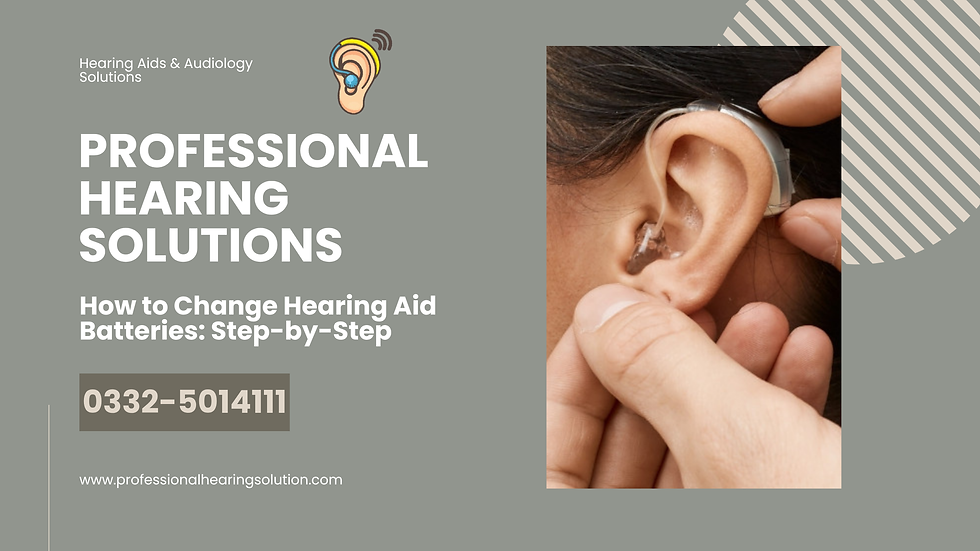
Need to change your hearing aid batteries? This step-by-step guide shows you exactly how — including tips for handling tiny batteries, especially for elderly patients. Read more: How Do Hearing Aids Aid Children's Learning?
Last Updated: March 2026
Expert help at Professional Hearing Solutions in Islamabad and Rawalpindi. Read more: Top Ear Aid Devices in Islamabad – Prices, Features & Brands
Step-by-Step Battery Change
1. Identify your battery size: Size 10 (yellow) for CIC/Silk. Size 312 (brown) for RIC. Size 13 (orange) for BTE. Size 675 (blue) for power BTE.
2. Open the battery door: Gently swing the battery door open using your fingernail or the provided tool.
3. Remove the old battery: Tip the hearing aid over your palm. The old battery should fall out gently.
4. Peel the sticker off the new battery: Remove the colored sticker tab. Wait 1-2 minutes before inserting — this activates the zinc-air battery.
5. Insert the new battery: Place with flat/positive (+) side up. It should sit flush in the compartment.
6. Close the door gently: Swing the door closed. It should click shut smoothly. Do not force it.
Battery Size Guide
Size | Color | Used In | Typical Life |
Size 10 | Yellow | CIC, IIC, Silk | 3-5 days |
Size 312 | Brown | RIC (Pure 312) | 5-7 days |
Size 13 | Orange | BTE (Motion) | 7-14 days |
Size 675 | Blue | Super Power BTE | 14-21 days |
Tips for Elderly Patients
Change batteries over a table or soft surface to avoid losing them
Use a magnetic battery tool if fingers are not dexterity-friendly
Keep spare batteries in a consistent, easy-to-find location
Ask a family member to help if handling is difficult
Consider upgrading to rechargeable models to eliminate battery changes entirely
How Hearing Loss Affects Daily Life
Hearing loss impacts more than just the ability to hear sounds. It affects communication, relationships, work performance, mental health, and overall quality of life. In Pakistan, where family gatherings, busy markets, and social interactions are central to daily life, hearing loss can be especially isolating.
Common Causes of Hearing Loss in Pakistan
Cause | Type of Hearing Loss | Preventable? | Common in Pakistan? |
Aging (Presbycusis) | Sensorineural | Not fully — manageable with hearing aids | Very common (60+ age group) |
Noise Exposure | Sensorineural | Yes — use hearing protection | Very common (traffic, factories) |
Ear Infections (Otitis Media) | Conductive | Yes — treat infections early | Common in children |
Genetic Factors | Sensorineural or Mixed | No — but early detection helps | Moderate |
Ototoxic Medications | Sensorineural | Yes — discuss with doctor | Moderate |
Head Trauma | Conductive or Mixed | Yes — wear safety equipment | Less common |
Earwax Blockage | Conductive | Yes — professional ear cleaning | Very common |
Signs You Should Get a Hearing Test
Frequently asking others to repeat themselves, especially in group conversations
Turning up the TV or phone volume higher than others find comfortable
Difficulty understanding speech in noisy environments like restaurants or family gatherings
Feeling that people are mumbling or speaking too softly
Avoiding social situations because of difficulty hearing
Ringing, buzzing, or hissing sounds in your ears (tinnitus)
Difficulty hearing doorbells, phone ringtones, or car horns
Treatment Options Available in Pakistan
Treatment | Best For | Available at PHS | Effectiveness |
Hearing Aids | Most hearing loss types | Yes — full Signia range | Highly effective |
Ear Wax Removal | Conductive loss from wax | Yes | Immediate improvement |
Medical Treatment | Ear infections, conditions | Referral provided | Depends on condition |
Surgical Options | Specific conductive cases | Referral to ENT | Case-dependent |
Tinnitus Management | Ringing/buzzing in ears | Yes — Signia notch therapy | Significant relief |
Do Not Ignore Hearing Loss
Research shows that untreated hearing loss is linked to cognitive decline, dementia, depression, social isolation, and increased fall risk. The longer hearing loss goes untreated, the harder it becomes for the brain to process speech. Early intervention with hearing aids preserves brain health and keeps you connected to the people and world around you.
If you or a family member shows signs of hearing loss, do not wait. Get a professional hearing assessment at Professional Hearing Solutions. Call 0332-5014111 or visit our Islamabad (Blue Area) or Rawalpindi (Saidpur Road) clinic.
Frequently Asked Questions
Q1: How do I know when the battery is low?
Most hearing aids beep when battery is low. Sound may also become weaker or distorted. Replace immediately when you hear the warning.
Q2: Where can I buy hearing aid batteries?
Professional Hearing Solutions carries all battery sizes. Call 0332-5014111.
Q3: Should I switch to rechargeable?
If battery changes are difficult, rechargeable models (Orion C&G from Rs.495,000/pair) eliminate this task entirely.
Related Articles You May Find Helpful
Explore Our Services
Note: Prices may vary slightly due to market fluctuations, currency exchange rates, and inflation. Contact Professional Hearing Solutions for the latest confirmed pricing.
Visit Professional Hearing Solutions
Islamabad Branch: Office B-9, Muhammad Gulistan Khan Plaza 82 East, Besides Tehzeeb Bakers, Fazl-ul-Haq Road, Blue Area, Islamabad, Pakistan
Google Maps: View Islamabad Location on Map
Rawalpindi Branch: Office 5/6, Ground Floor, Siraj Plaza, Opposite Rasheed Nursing Home, Adjacent Gulzari Optics, Saidpur Road, Rawalpindi
Google Maps: View Rawalpindi Location on Map
Phone/WhatsApp: 0332-5014111
Website: www.professionalhearingsolution.com
Conclusion
Changing hearing aid batteries is simple once you know the process. If battery handling is difficult, consider rechargeable models. Call 0332-5014111.